
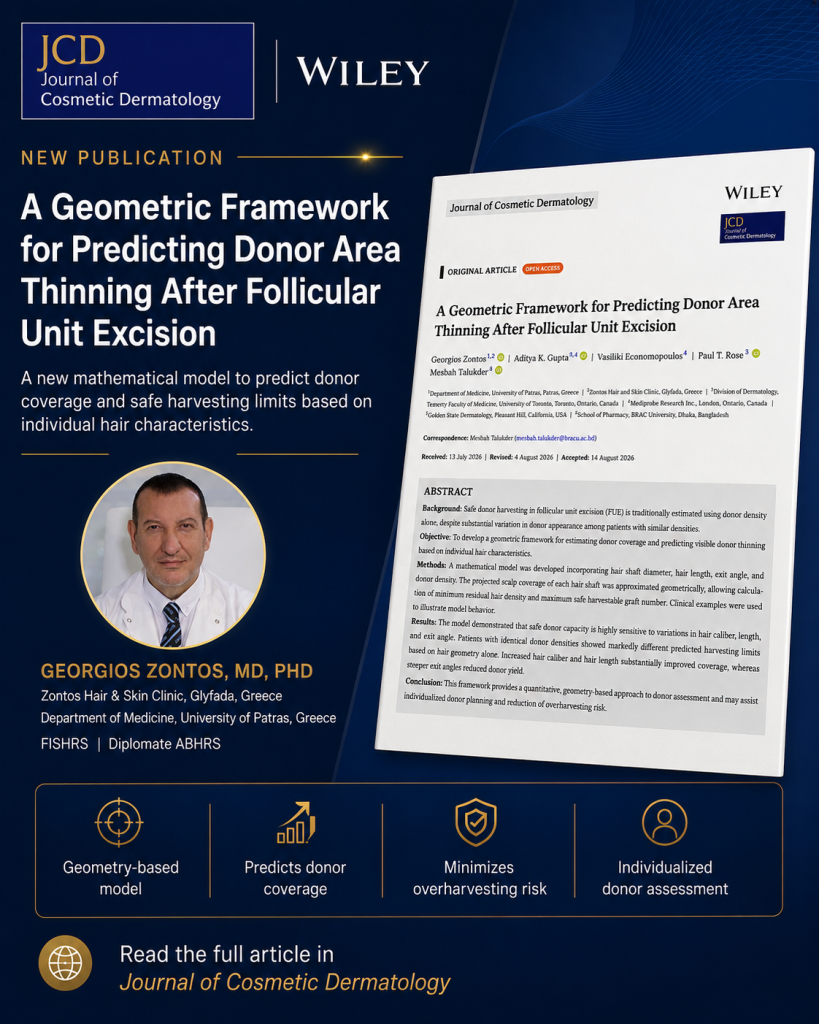
Dr. Georgios Zontos introduces a new geometric framework for quantifying the risk of visible donor-area thinning
Zontos Hair & Skin Clinic proudly announces the publication of a significant new scientific study, led by Georgios Zontos, MD, PhD, FISHRS, Diplomate ABHRS, in the international peer-reviewed Journal of Cosmetic Dermatology.
The study, entitled “A Geometric Framework for Predicting Donor Area Thinning After Follicular Unit Excision,” addresses one of the fundamental questions in modern hair transplantation:
How much hair can be safely harvested by FUE before donor-area thinning becomes visibly apparent?
The publication is available in Journal of Cosmetic Dermatology:
https://onlinelibrary.wiley.com/doi/10.1111/jocd.71156
From empirical estimation to quantification
Traditionally, donor capacity has been assessed largely on the basis of hair density and the surgeon’s clinical experience. Density alone, however, cannot fully describe the actual visual coverage of the donor area.
This new study takes a fundamentally different approach.
To our knowledge, this is the first published unified geometric model designed to quantify the problem of visible donor thinning following FUE by simultaneously incorporating the critical measurable parameters that determine donor coverage: hair density, hair shaft diameter, hair length and hair exit angle.
The question therefore moves beyond simply asking “How many hairs are present per cm²?” to asking “How much actual geometric coverage do those hairs provide?”
This distinction is critical. Two patients with identical hair density may have markedly different visual donor coverage and, consequently, different predicted safe harvesting capacities. The proposed framework transforms these individual characteristics into measurable variables and mathematical relationships.
Toward truly individualized FUE donor planning
The study goes further by challenging the concept of treating the donor area as a single homogeneous zone.
Occipital, parietal and temporal regions may differ in density, hair caliber and exit angle. The framework can therefore be applied region by region, allowing harvesting strategies to reflect the actual characteristics of each donor subregion rather than relying on a single global average.
This represents an important step toward moving FUE donor planning away from generalized empirical thresholds and toward a more individualized, quantitative and scientifically grounded approach, with the ultimate objective of preserving donor aesthetics and minimizing the risk of overharvesting.
The article has been published Open Access, making the complete study freely available to the international scientific community.